
Recently, I have had cause to think deeply about what has been happening in our neuroimaging field over the years. This month in particular had me dwelling in the past more than I usually do. We all tend to inhabit our own little compartments some times, so it is healthy to expand out and look at the big picture and into the distance from time-to-time…
This month of December [2024] sees 4 years since the passing of Dr. Leslie Ungerleider, an amazing neuroscientist who shaped the field of human and non-human primate visual neurophysiology, neuroanatomy and neuroimaging for about 5 decades. She was an ‘influencer‘ before the word became fashionable. She influenced our thinking about science, as well as our science itself. Her biography and a lovely obituary written by a dear colleague, Dr. Marlene Behrmann, can be accessed here: Leslie G. Ungerleider (1946–2020): The multiple careers of a single extraordinary scientist. Nature Neuroscience 2021, 24: 291-292. https://doi.org/10.1038/s41593-021-00808-6

When I was OHBM Council Chair [President] in 2020, we awarded Leslie the Glass Brain Award, our lifetime achievement award for outstanding senior scientists. I had the good fortune to sit down with Leslie in June 2020 and do an interview on Zoom, which lasted for about an hour. That year, we had to hold our annual OHBM scientific meeting completely online, due to the COVID-19 lockdown… Little did we know at the time that we would lose Leslie very suddenly on December 11, 2020.
Needless to say, the interview was widely viewed, as the then NIH Director, Dr. Francis Collins, ensured that her many friends and colleagues in the NIH community had access to the video. In that interview, she showed us not only her scientific face and how she felt about her many scientific accomplishments over the decades, but she also showed her personal side as well. It is rare for a scientist of that calibre to be so empathic, compassionate and mindful of others [at least in my experience]. The interview is accessible here: https://www.youtube.com/watch?v=zt4i71bXrcw
In September 2022, Drs. Alex Martin, Chris Baker, Shruti Japee and Peter Bandettini organized a 2-day Symposium in Leslie’s honor at the NIH in Bethesda, MD, USA. It was entitled: Neural Foundations of Vision & Cognition: Symposium in Honor of Leslie G Ungerleider. The videos across the 2 days are available. Day 1 video: https://videocast.nih.gov/watch=46046 ; Day 2 video: https://videocast.nih.gov/watch=46048 ] Here is a group photo of the symposium speakers:
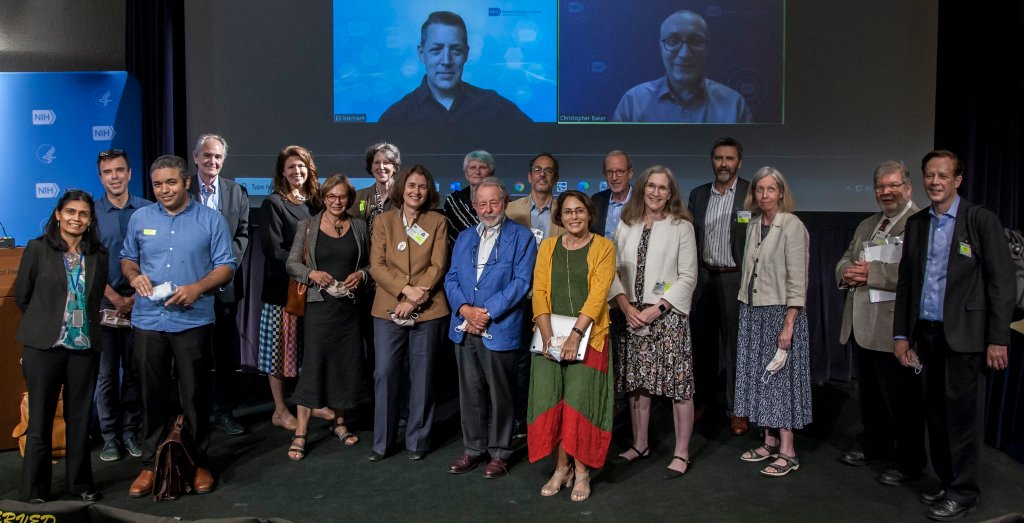
Yours truly is in the back row center with green hair!… unfortunate timing in some ways. That said, you just have to roll with that and go with the one-liners. This was a necessity – everyone who presented had a hard time holding it together. [I had personally practiced my talk about 10 times or so at home before I left for Washington, just so I could get through it without crying. Fortunately, I was able to complete my talk fine, but nonetheless I was still emotionally really rattled on the inside.] Thankfully, people told amusing anecdotes which helped all of us remember some of the wackier things that had happened in Leslie’s presence. My own story in that regard involved a walk with her and Karl Friston at the San Antonio, TX OHBM meeting – we were returning to the meeting after having lunch and were walking along the Riverwalk – a very scenic, but narrow, walkway with no barriers to the river.

Leslie was walking in front of the two of us because it was too narrow to walk 3 abreast. She tripped and stumbled… for a split-second Karl and I thought she was going to fall and break a bone, or worse still, end up in the river! At the Symposium I related this story and showed a slide [see below] that I had made, in collusion with Karl, to visually portray that awful moment when for a few microseconds both of us were extremely fearful…

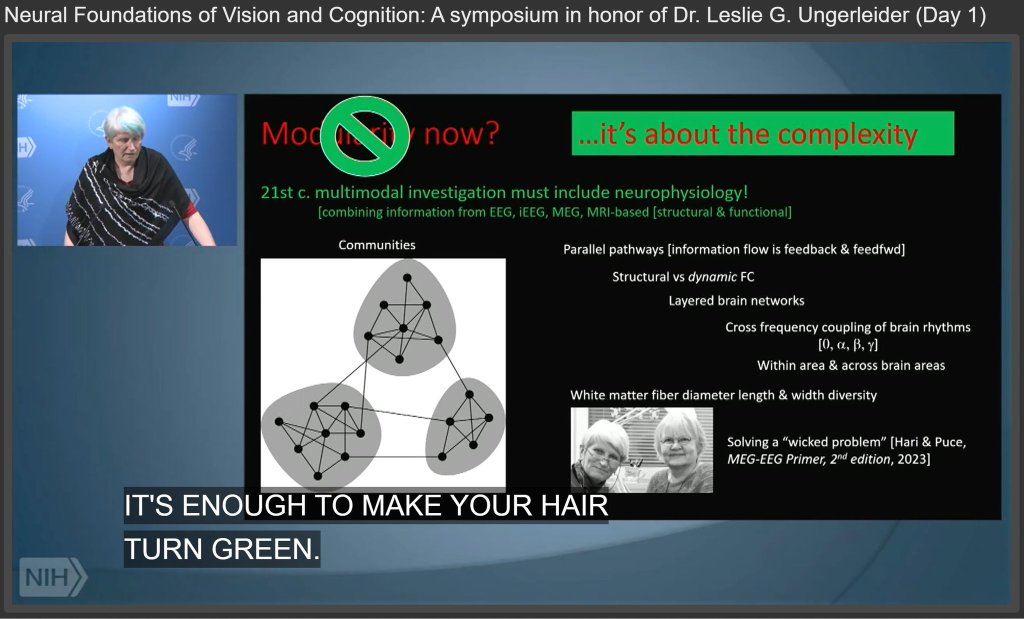
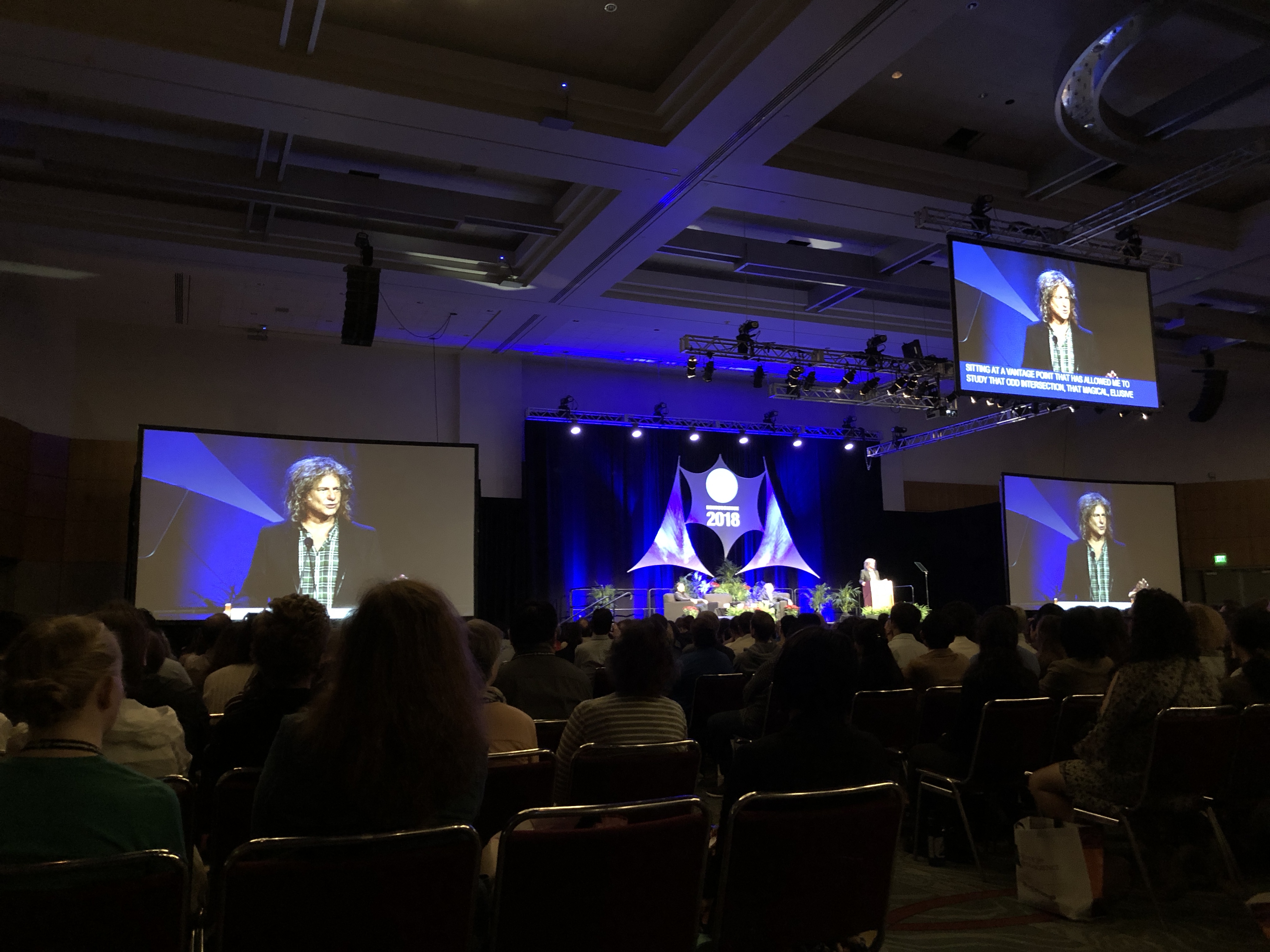
In my talk I ended up presenting some unpublished scientific data as an anecdote, ending with the [predictable and somewhat lame] punchline: “It’s enough to make your hair turn green!” The talk had subtitles, so someone in the audience snapped a shot of that and, of course, it ended up in the Twittersphere…
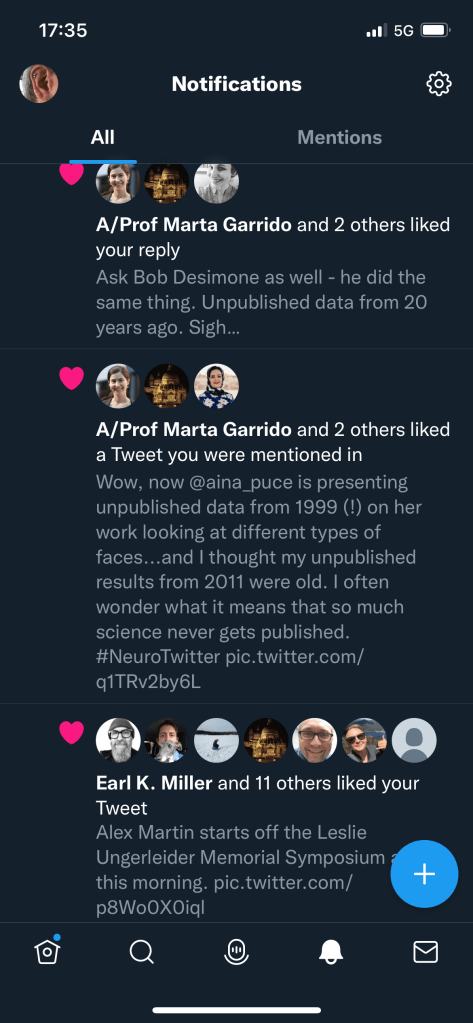
…but I was not the only one to present unpublished data from way back. So, I was in good company!
Overall, it was a tremendous meeting – with a lot of impressive scientific data presented by many people, including the late Dr. Susan Courtney, shown here starting her presentation.
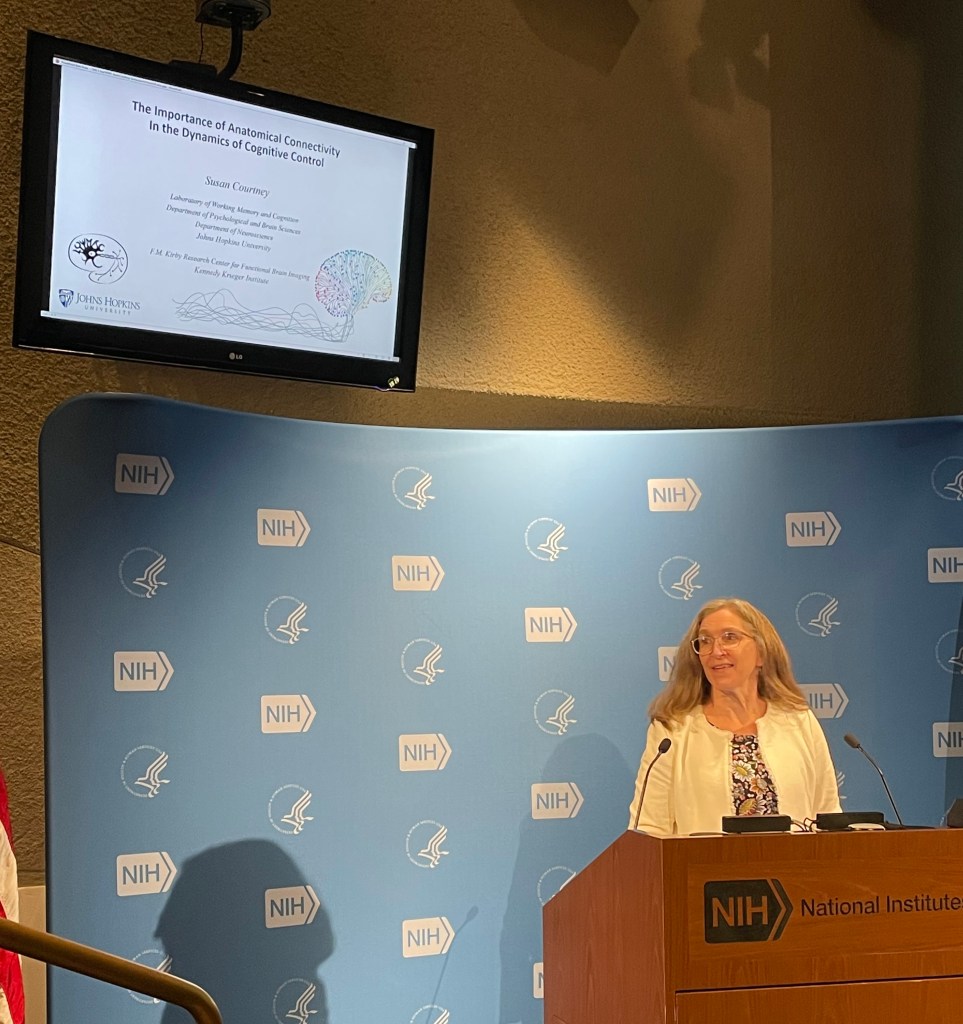
Tragically, Susan passed away suddenly at the age of 57 years on June 10th, this year. [https://hub.jhu.edu/2024/06/13/susan-courtney-obituary/] Needless to say, we are all still trying to process this terrible loss as well… It has certainly been a very tough time for our colleagues in the NIMH’s Laboratory of Brain and Cognition over these last 4 years!
Susan and I go back a long way – we were both post-docs at exactly the same time [1993 onwards] when our respective laboratories were working in trying to get functional MRI studies up and running for the first time. She was in Leslie’s lab at the NIMH, whereas I was in Truett Allison and Greg McCarthy’s lab at Yale. We spent a lot of wonderful quality scientific and social time at scientific meetings together. Indeed, I always was fortunate to participate in the activities of that NIMH Lab, particularly when we were all out of the country together at a scientific meeting. The other senior lab scientists such as Jim Haxby and Alex Martin were always so collegial and inclusive to me. I will always be grateful for that.
Indeed, let me turn this somewhat sombre post around a bit with another anecdote – but this time at Dr. Jim Haxby’s expense! When we attended the Memorial Symposium we were bussed from our hotel with a special NIH shuttle, which was a black van with blacked out windows and no logos on its sides. We were all a bit hesitant to get on board – who knew where we were going to end up – Langley perhaps? On entering the NIH campus, all vehicles must go through a security check, including ours. This means everyone exits their car, bus etc. while their vehicle is thoroughly searched and checked. While we were standing out by the kerb enjoying the delightful morning sunshine and perfectly blue sky, one of the NIH administrative assistants handed out our security passes for the day – a good and efficient thing to do! As we were all pinning our ID cards on our lapels etc. Jim dropped his badge. It slid down the incline we were standing on and headed towards an open gutter. For a split-second we all froze as we watched it slide – and no-one was in reaching distance to rescue the badge! I wish someone had snapped that moment on a cellphone – to catch the collective fear on all of our faces, including Jim’s of course! Miraculously, the badge’s slide stopped – millimeters from disappearing into the void. If I recall correctly, someone suggested to Jim that he should immediately go out and purchase a lottery ticket…
The 2-day symposium was scientifically successful, but more so, despite it being emotionally draining, it also gave many of us some closure on Leslie’s passing… After the symposium ended, those of us who were still going to be in town that evening ended up going to have some dinner and drinks at the Rock Bottom Bar – a usual haunt for NIHers. This time, it was an extra-special evening. Some members of Leslie’s family were in town, for a memorial service the next day. They had been told that we would be grabbing some dinner there, so they dropped by. I was able to meet and chat with her sister and brother. They are not scientists, but nevertheless are accomplished individuals in their chosen professions in the arts. What an amazing family they are!
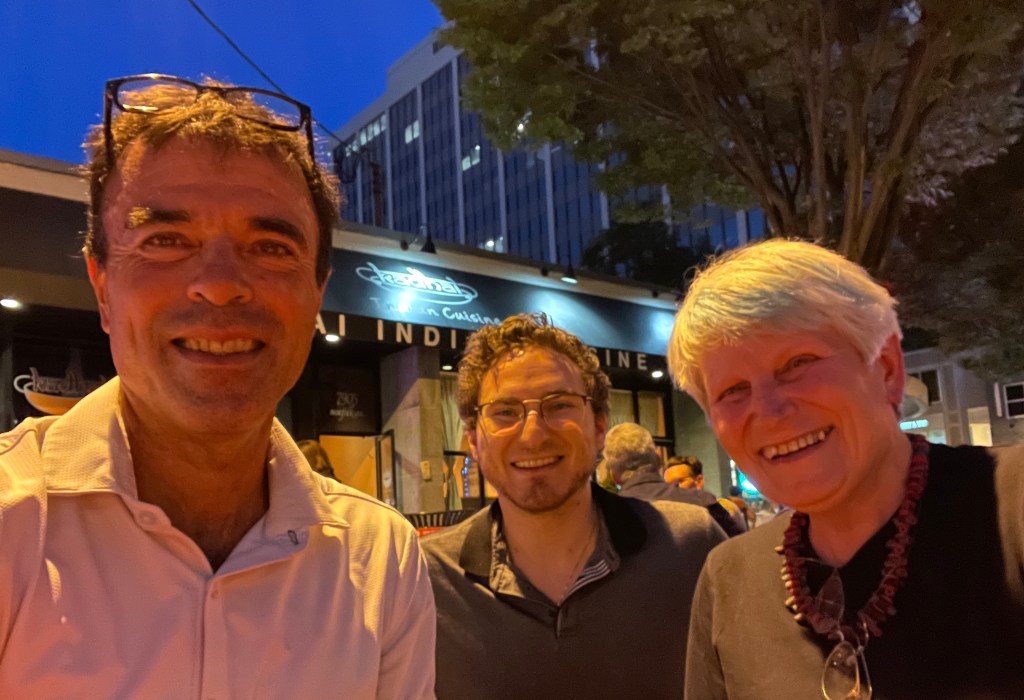
I was also able to say hello to an ex-graduate student [a.k.a. the newly-minted Dr Josh Faskowitz] from our department, who was now doing his post-doc with Peter Bandettini at NIMH – in the neuroimaging core. Here we are catching up that evening – Peter is on the left and Josh is in the center. It was an unseasonably warm late-September evening – a beautiful night to sit and enjoy eating outdoors and catching up with old friends, as well as making new ones!
So, now we are in December 2024. The Journal of Cognitive Neuroscience has devoted this month to a special issue in Dr. Leslie Ungerleider’s memory: From Cells to Circuits, from Vision to Cognition, from Monkeys to Humans: Leslie Ungerleider’s Pioneering Neuroscience.
If you are interested, my paper is: Puce A. (2024). From motion to emotion: Visual pathways and potential interconnections. J Cogn Neurosci 36: 2594–2617 https://doi.org/10.1162/jocn_a_02141
It is really hard for us to believe that it has been 4 years since Leslie’s passing – Peter and I were talking about this the other day on Zoom. We all need to send a big thank you to Drs. Chris Baker and Sabine Kastner for going the hard yards and herding us all to successfully submit and publish our Symposium papers for the special issue. A big shout out also to Editor-in-Chief of Journal of Cognitive Neuroscience, Dr. Bradley Postle, for generously giving us a forum to present our science and honor Leslie in this way.



 neurowanderer.blog