Thinking about visual [e]motion & very special colleagues who are no longer with us…

Recently, I have had cause to think deeply about what has been happening in our neuroimaging field over the years. This month in particular had me dwelling in the past more than I usually do. We all tend to inhabit our own little compartments some times, so it is healthy to expand out and look at the big picture and into the distance from time-to-time…
This month of December [2024] sees 4 years since the passing of Dr. Leslie Ungerleider, an amazing neuroscientist who shaped the field of human and non-human primate visual neurophysiology, neuroanatomy and neuroimaging for about 5 decades. She was an ‘influencer‘ before the word became fashionable. She influenced our thinking about science, as well as our science itself. Her biography and a lovely obituary written by a dear colleague, Dr. Marlene Behrmann, can be accessed here: Leslie G. Ungerleider (1946–2020): The multiple careers of a single extraordinary scientist. Nature Neuroscience 2021, 24: 291-292. https://doi.org/10.1038/s41593-021-00808-6

When I was OHBM Council Chair [President] in 2020, we awarded Leslie the Glass Brain Award, our lifetime achievement award for outstanding senior scientists. I had the good fortune to sit down with Leslie in June 2020 and do an interview on Zoom, which lasted for about an hour. That year, we had to hold our annual OHBM scientific meeting completely online, due to the COVID-19 lockdown… Little did we know at the time that we would lose Leslie very suddenly on December 11, 2020.

Needless to say, the interview was widely viewed, as the then NIH Director, Dr. Francis Collins, ensured that her many friends and colleagues in the NIH community had access to the video. In that interview, she showed us not only her scientific face and how she felt about her many scientific accomplishments over the decades, but she also showed her personal side as well. It is rare for a scientist of that calibre to be so empathic, compassionate and mindful of others [at least in my experience]. The interview is accessible here: https://www.youtube.com/watch?v=zt4i71bXrcw

In September 2022, Drs. Alex Martin, Chris Baker, Shruti Japee and Peter Bandettini organized a 2-day Symposium in Leslie’s honor at the NIH in Bethesda, MD, USA. It was entitled: Neural Foundations of Vision & Cognition: Symposium in Honor of Leslie G Ungerleider. The videos across the 2 days are available. Day 1 video: https://videocast.nih.gov/watch=46046 ; Day 2 video: https://videocast.nih.gov/watch=46048 ] Here is a group photo of the symposium speakers:
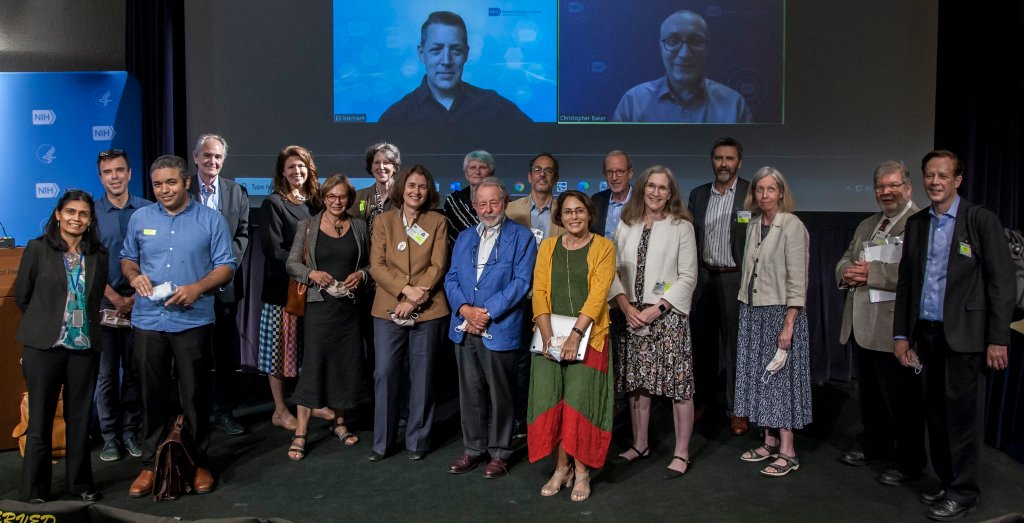
Yours truly is in the back row center with green hair!… unfortunate timing in some ways. That said, you just have to roll with that and go with the one-liners. This was a necessity – everyone who presented had a hard time holding it together. [I had personally practiced my talk about 10 times or so at home before I left for Washington, just so I could get through it without crying. Fortunately, I was able to complete my talk fine, but nonetheless I was still emotionally really rattled on the inside.] Thankfully, people told amusing anecdotes which helped all of us remember some of the wackier things that had happened in Leslie’s presence. My own story in that regard involved a walk with her and Karl Friston at the San Antonio, TX OHBM meeting – we were returning to the meeting after having lunch and were walking along the Riverwalk – a very scenic, but narrow, walkway with no barriers to the river.

Leslie was walking in front of the two of us because it was too narrow to walk 3 abreast. She tripped and stumbled… for a split-second Karl and I thought she was going to fall and break a bone, or worse still, end up in the river! At the Symposium I related this story and showed a slide [see below] that I had made, in collusion with Karl, to visually portray that awful moment when for a few microseconds both of us were extremely fearful…

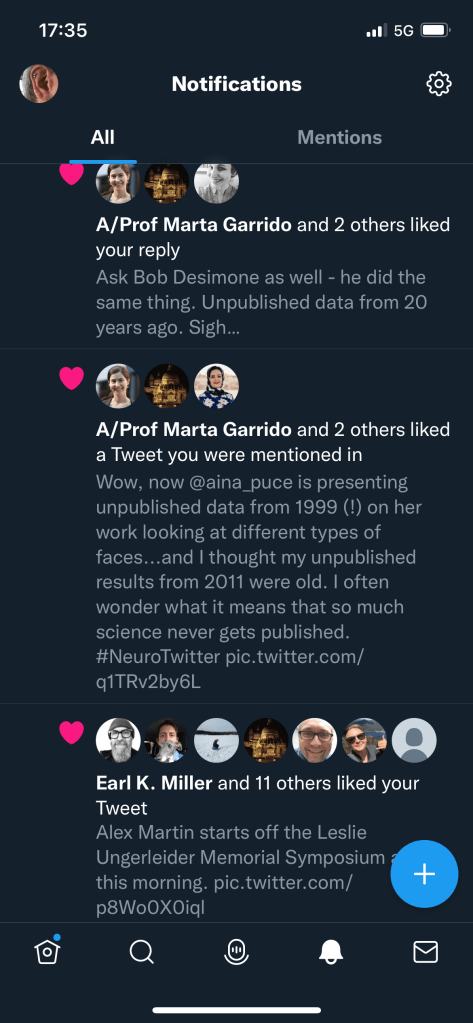
In my talk I ended up presenting some unpublished scientific data as an anecdote, ending with the [predictable and somewhat lame] punchline: “It’s enough to make your hair turn green!” The talk had subtitles, so someone in the audience snapped a shot of that and, of course, it ended up in the Twittersphere…
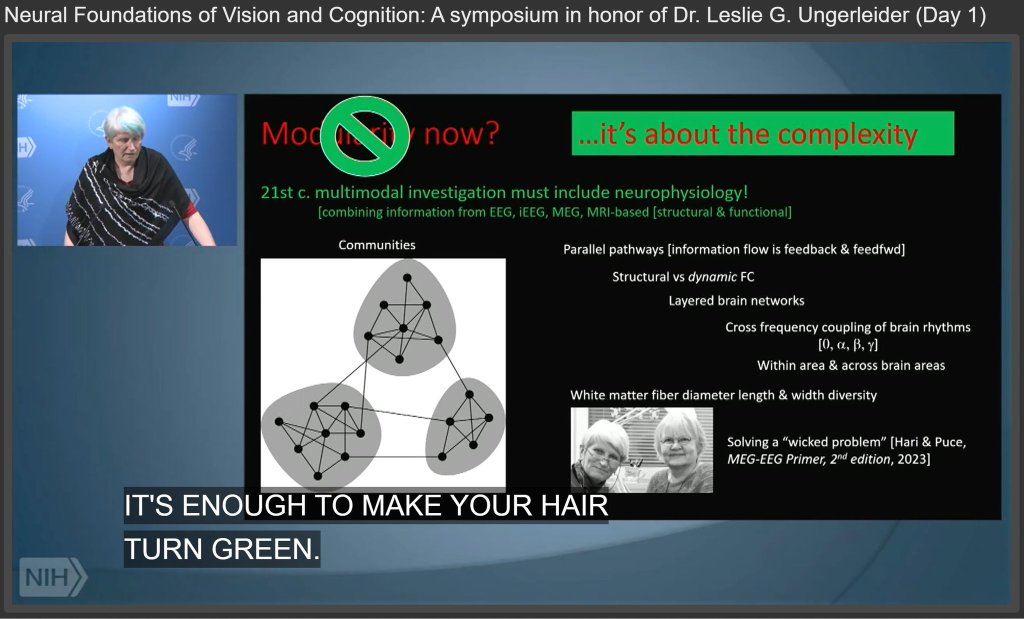
…but I was not the only one to present unpublished data from way back. So, I was in good company!
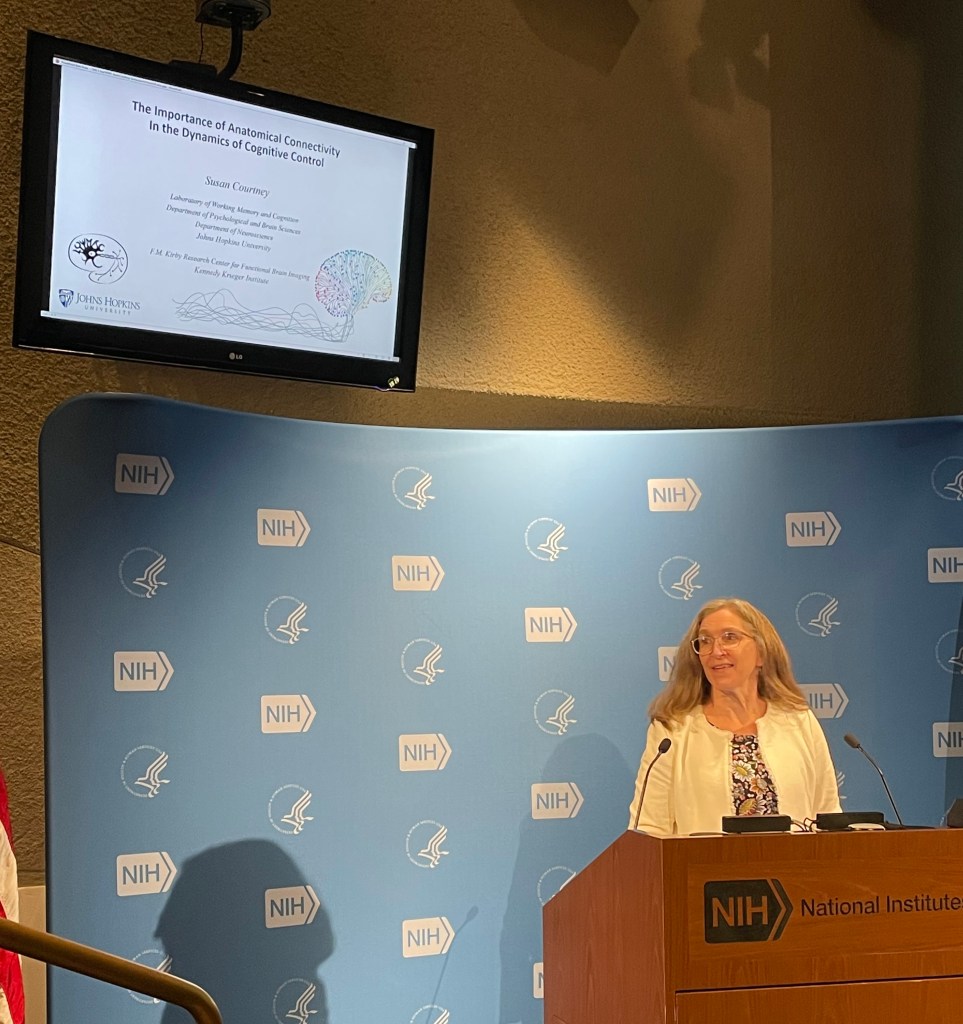
Overall, it was a tremendous meeting – with a lot of impressive scientific data presented by many people, including the late Dr. Susan Courtney, shown here starting her presentation.
Tragically, Susan passed away suddenly at the age of 57 years on June 10th, this year. [https://hub.jhu.edu/2024/06/13/susan-courtney-obituary/] Needless to say, we are all still trying to process this terrible loss as well… It has certainly been a very tough time for our colleagues in the NIMH’s Laboratory of Brain and Cognition over these last 4 years!

Susan and I go back a long way – we were both post-docs at exactly the same time [1993 onwards] when our respective laboratories were working in trying to get functional MRI studies up and running for the first time. She was in Leslie’s lab at the NIMH, whereas I was in Truett Allison and Greg McCarthy’s lab at Yale. We spent a lot of wonderful quality scientific and social time at scientific meetings together. Indeed, I always was fortunate to participate in the activities of that NIMH Lab, particularly when we were all out of the country together at a scientific meeting. The other senior lab scientists such as Jim Haxby and Alex Martin were always so collegial and inclusive to me. I will always be grateful for that.

Indeed, let me turn this somewhat sombre post around a bit with another anecdote – but this time at Dr. Jim Haxby’s expense! When we attended the Memorial Symposium we were bussed from our hotel with a special NIH shuttle, which was a black van with blacked out windows and no logos on its sides. We were all a bit hesitant to get on board – who knew where we were going to end up – Langley perhaps? On entering the NIH campus, all vehicles must go through a security check, including ours. This means everyone exits their car, bus etc. while their vehicle is thoroughly searched and checked. While we were standing out by the kerb enjoying the delightful morning sunshine and perfectly blue sky, one of the NIH administrative assistants handed out our security passes for the day – a good and efficient thing to do! As we were all pinning our ID cards on our lapels etc. Jim dropped his badge. It slid down the incline we were standing on and headed towards an open gutter. For a split-second we all froze as we watched it slide – and no-one was in reaching distance to rescue the badge! I wish someone had snapped that moment on a cellphone – to catch the collective fear on all of our faces, including Jim’s of course! Miraculously, the badge’s slide stopped – millimeters from disappearing into the void. If I recall correctly, someone suggested to Jim that he should immediately go out and purchase a lottery ticket…

The 2-day symposium was scientifically successful, but more so, despite it being emotionally draining, it also gave many of us some closure on Leslie’s passing… After the symposium ended, those of us who were still going to be in town that evening ended up going to have some dinner and drinks at the Rock Bottom Bar – a usual haunt for NIHers. This time, it was an extra-special evening. Some members of Leslie’s family were in town, for a memorial service the next day. They had been told that we would be grabbing some dinner there, so they dropped by. I was able to meet and chat with her sister and brother. They are not scientists, but nevertheless are accomplished individuals in their chosen professions in the arts. What an amazing family they are!

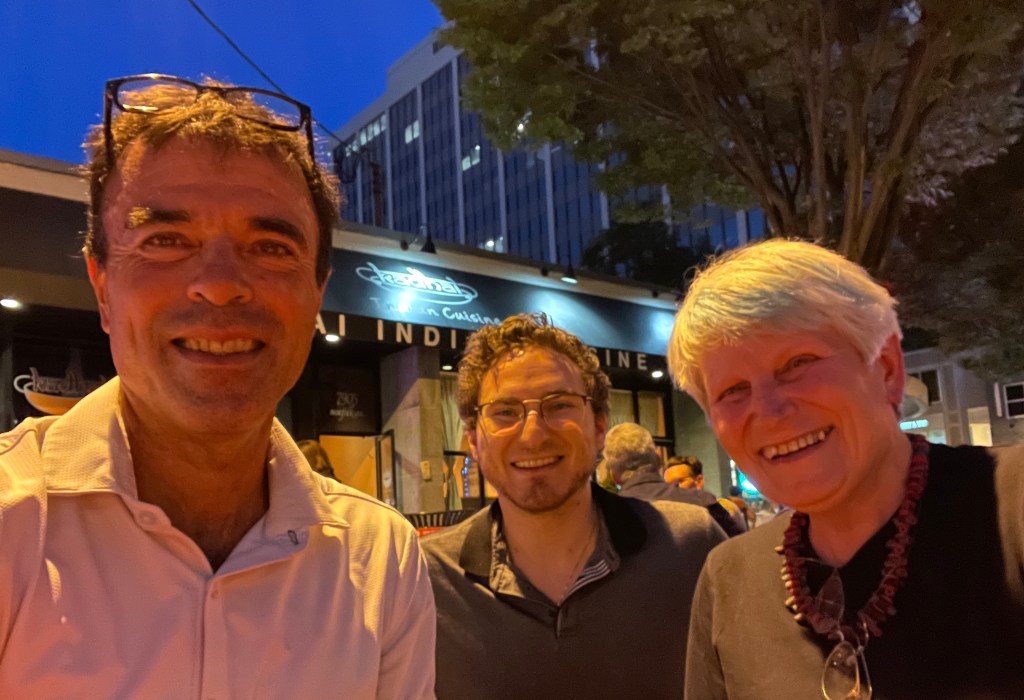
I was also able to say hello to an ex-graduate student [a.k.a. the newly-minted Dr Josh Faskowitz] from our department, who was now doing his post-doc with Peter Bandettini at NIMH – in the neuroimaging core. Here we are catching up that evening – Peter is on the left and Josh is in the center. It was an unseasonably warm late-September evening – a beautiful night to sit and enjoy eating outdoors and catching up with old friends, as well as making new ones!
So, now we are in December 2024. The Journal of Cognitive Neuroscience has devoted this month to a special issue in Dr. Leslie Ungerleider’s memory: From Cells to Circuits, from Vision to Cognition, from Monkeys to Humans: Leslie Ungerleider’s Pioneering Neuroscience.

If you are interested, my paper is: Puce A. (2024). From motion to emotion: Visual pathways and potential interconnections. J Cogn Neurosci 36: 2594–2617 https://doi.org/10.1162/jocn_a_02141

It is really hard for us to believe that it has been 4 years since Leslie’s passing – Peter and I were talking about this the other day on Zoom. We all need to send a big thank you to Drs. Chris Baker and Sabine Kastner for going the hard yards and herding us all to successfully submit and publish our Symposium papers for the special issue. A big shout out also to Editor-in-Chief of Journal of Cognitive Neuroscience, Dr. Bradley Postle, for generously giving us a forum to present our science and honor Leslie in this way.

Post #OHBMx Twitter conference thoughts & also thank-yous…

So the Equinox is over & we are officially into Spring. Does not seem that way. I was recording my online lecture yesterday afternoon now that we are in COVID-19 social isolationg & had to pause the recording because I noticed it was snowing & we had plants outside! But that is the rollercoaster of Spring here in the US midwest.

In my previous post I featured most of the people in Team OHBMx – the machine behind https://ohbmx.org/ & @OHBMequinoX, but I did not get to everyone. The Aussie Hub started us off with Michael Breakspear‘s Keynote – a fabulous investigation of brain activity modes in premature babies. Tour de force investigation in so many ways – hard to get this activity in the first place, difficult to source model because of fontanelles, lots of technical issues to solve… A great way to kick us off & with lots of excitement in response to his talk. Ppl were tweeting to signal the start of #OHBMx to draw attention to the meeting [#OHBMx program is here for those of you who missed it: https://ohbmx.org/program/]

Of course Michael’s Keynote Tweets can be viewed here: https://twitter.com/OHBMequinoX/status/1240820864083349505 While Michael Breakspear [@DrBreaky] was keynote tweeting, behind the scenes the Aussie hub was working hard. Pressure was on – they were starting off the 24 hour meeting & were the ‘new kids on the block’ relative to the Euro & US hubs – no pressure… Incredible efforts by Megan Campbell [@MegaEJ_Campbell], Léonie Horne [@LeonieBorne] & Nikitas Koussis [@KoussisNikitas]!!! They started the meeting off beautifully – everything running smoothly. [And this is easier said than done…] Thank you so much for volunteering to do this! Their smiling faces appear below:

And from the US hub we also had Sheran Khan – his photo appears further down in our feed.

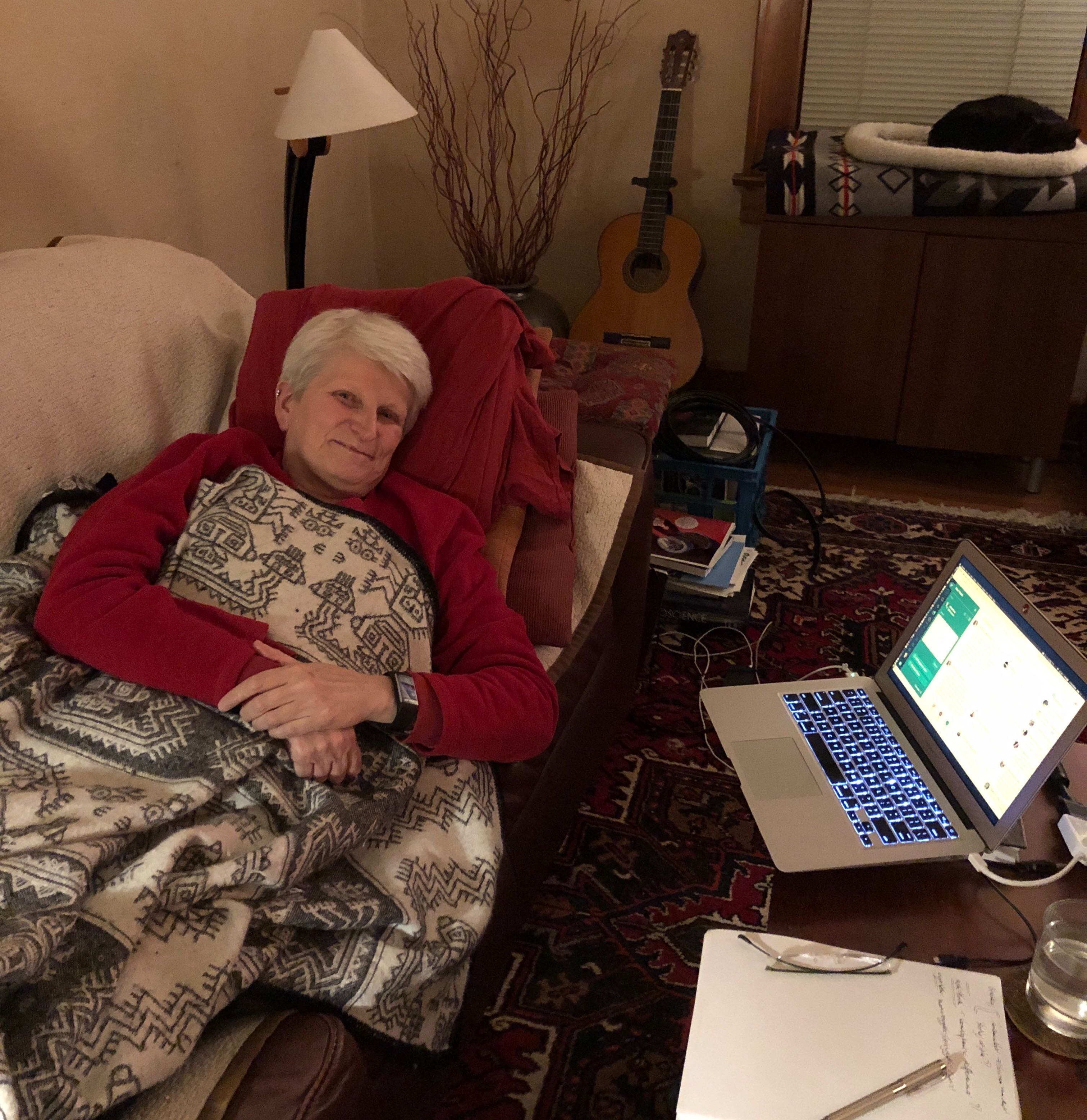
While the hubs were doing their thing, I was valiantly trying to stay awake for the duration – to try to ask questions, offer suggestions & make comments etc. So I decided that I would make my #OHBMx headquarters in our Man Cave at home – booted the other half out of there for 24 hours. Nah, not quite, he was coming in to follow along the fun while he was awake. Here is my ‘pajama’ picture from the couch around 11 pm or so – we started at 10 pm our time.

PuceInManCave

Over the course of next 24 hours, I confess: I lasted 23 24 hours. I had my two trusty editorial assistants helping out – initially they were on the couch watching the action, but later when everything was under control they decided to retire to the periphery of the Man Cave – in the right pic below you can see daylight as we are into the next day already here!

As the conference progressed the tweeting began to show more & more creative use of video, which prompted Team OHBMx Head Enrico Glerean [@eglerean] to issue a challenge: perhaps we might consider an award for the best video! There were many very amusing videos – which of course were right on track with the presentations, but my personal favorite was Léonie Horne’s. Why? Because she starred in it herself & it was very witty & fitted totally with her chosen theme!

The transition from the Aussie hub to Euro hub was seamless:

I confess that I missed the transition. I was practicing the ancient art of human brain napping. Why? In addition to taking rests between devoting my full attention to scientific presentations, in our location we had a deluge – 15 cm [6 inches] of rain in the 24 hour period that was #OHBMx. This meant that during the night I was also having to run down to our basement to make sure that the incoming water would not get out of control. Was able to contain it to one location & deal with it. Lucky thing I was up all night, otherwise it would have been quite an unpleasant surprise in the basement the next day!

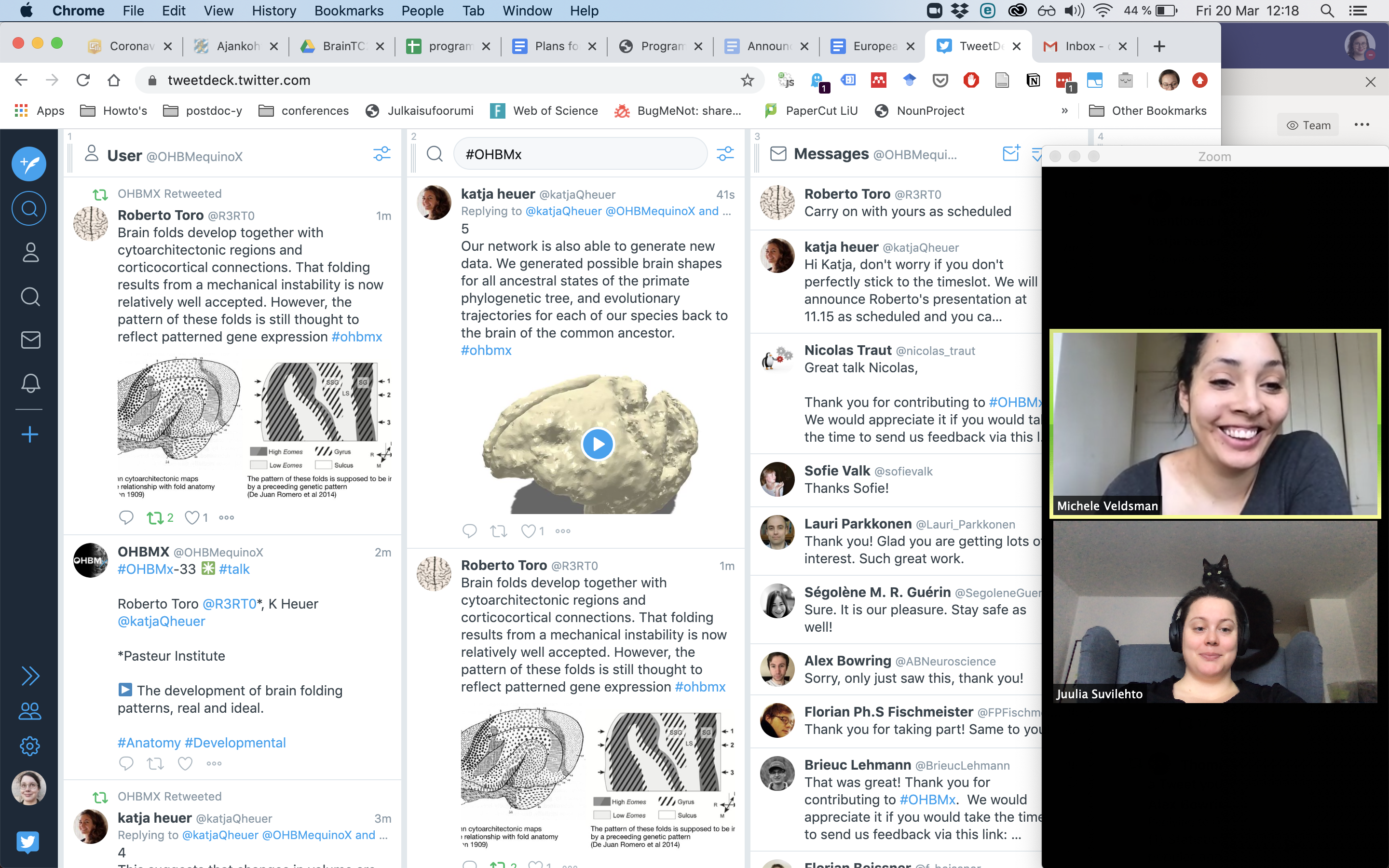
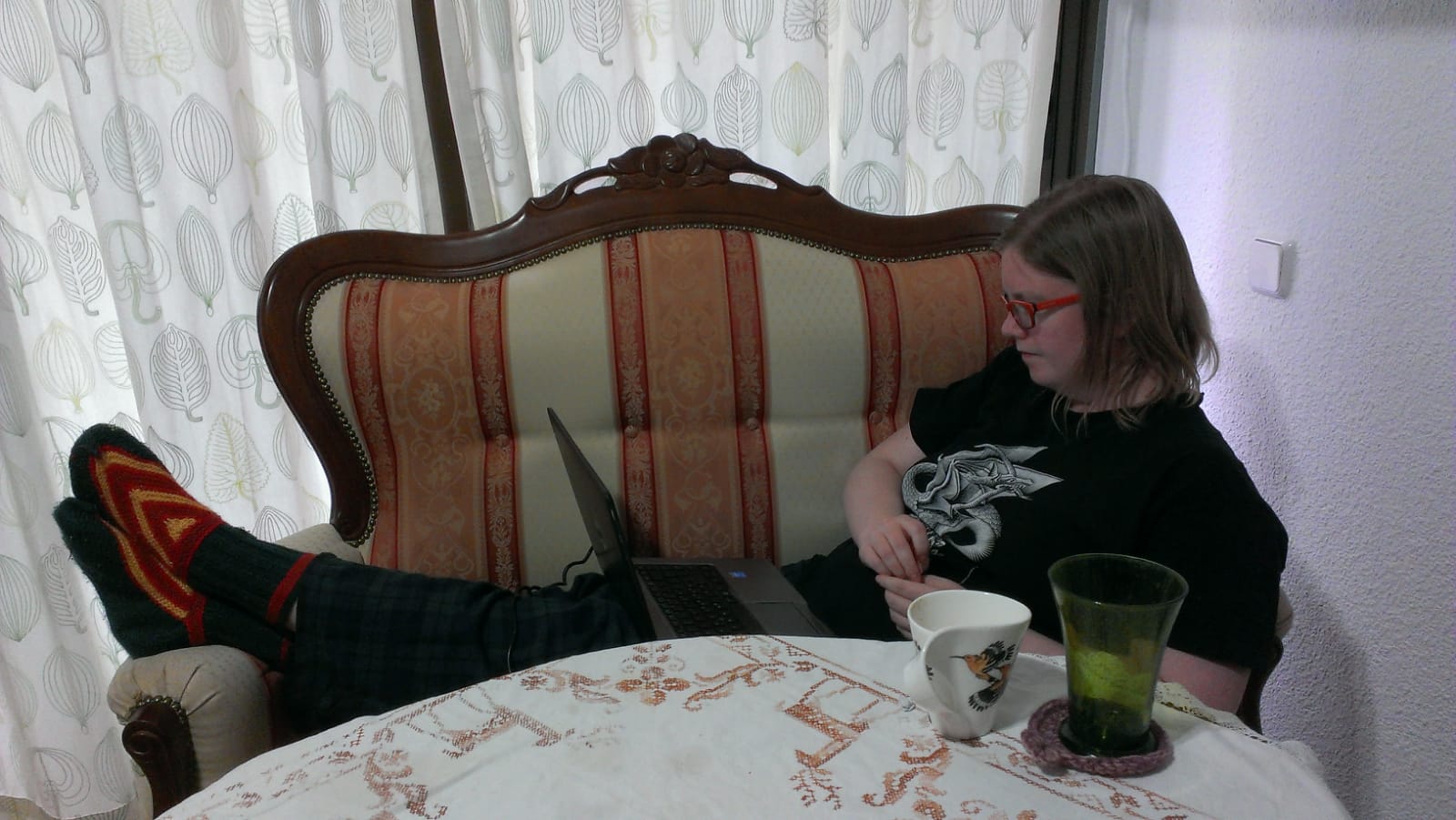
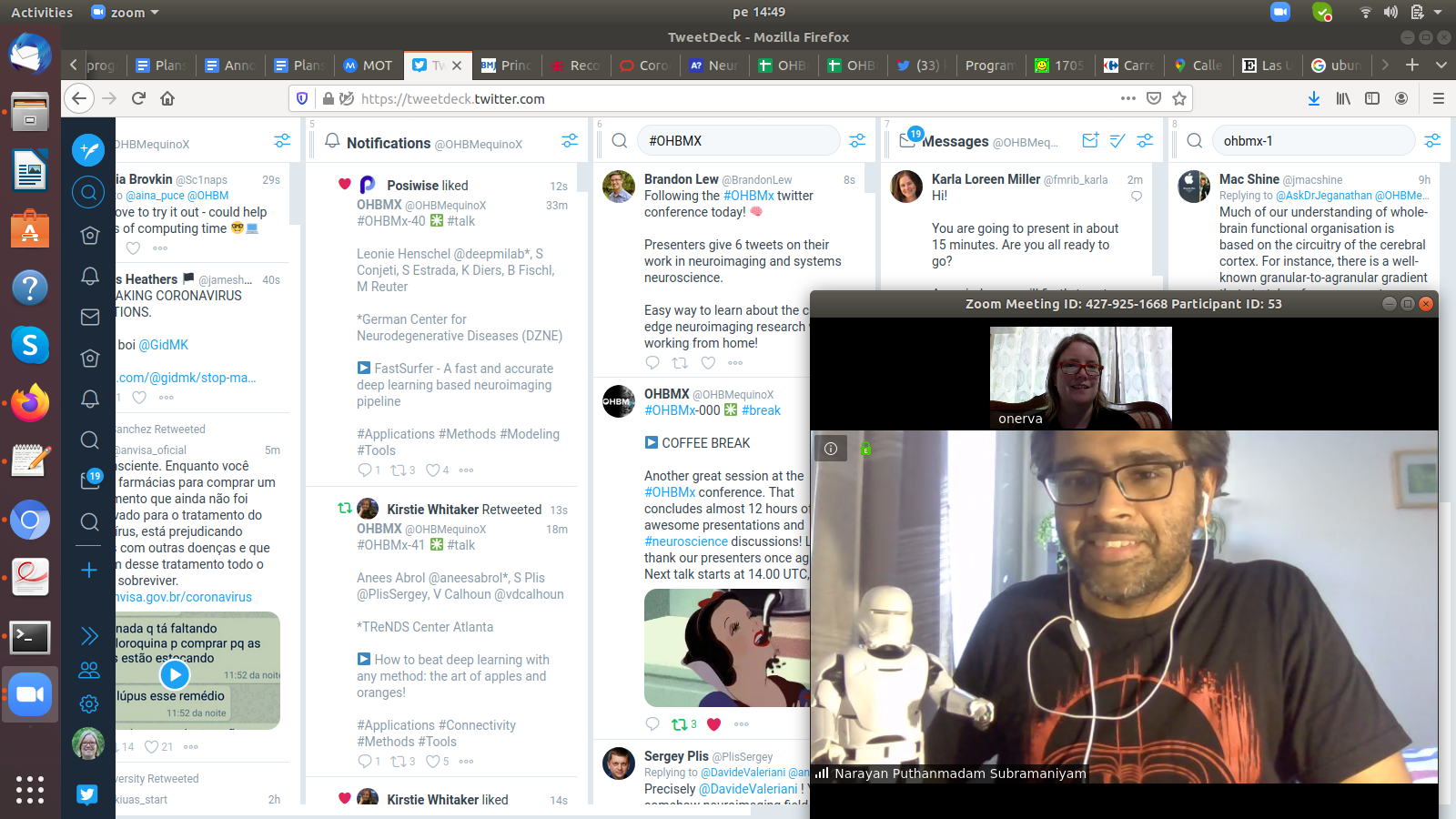
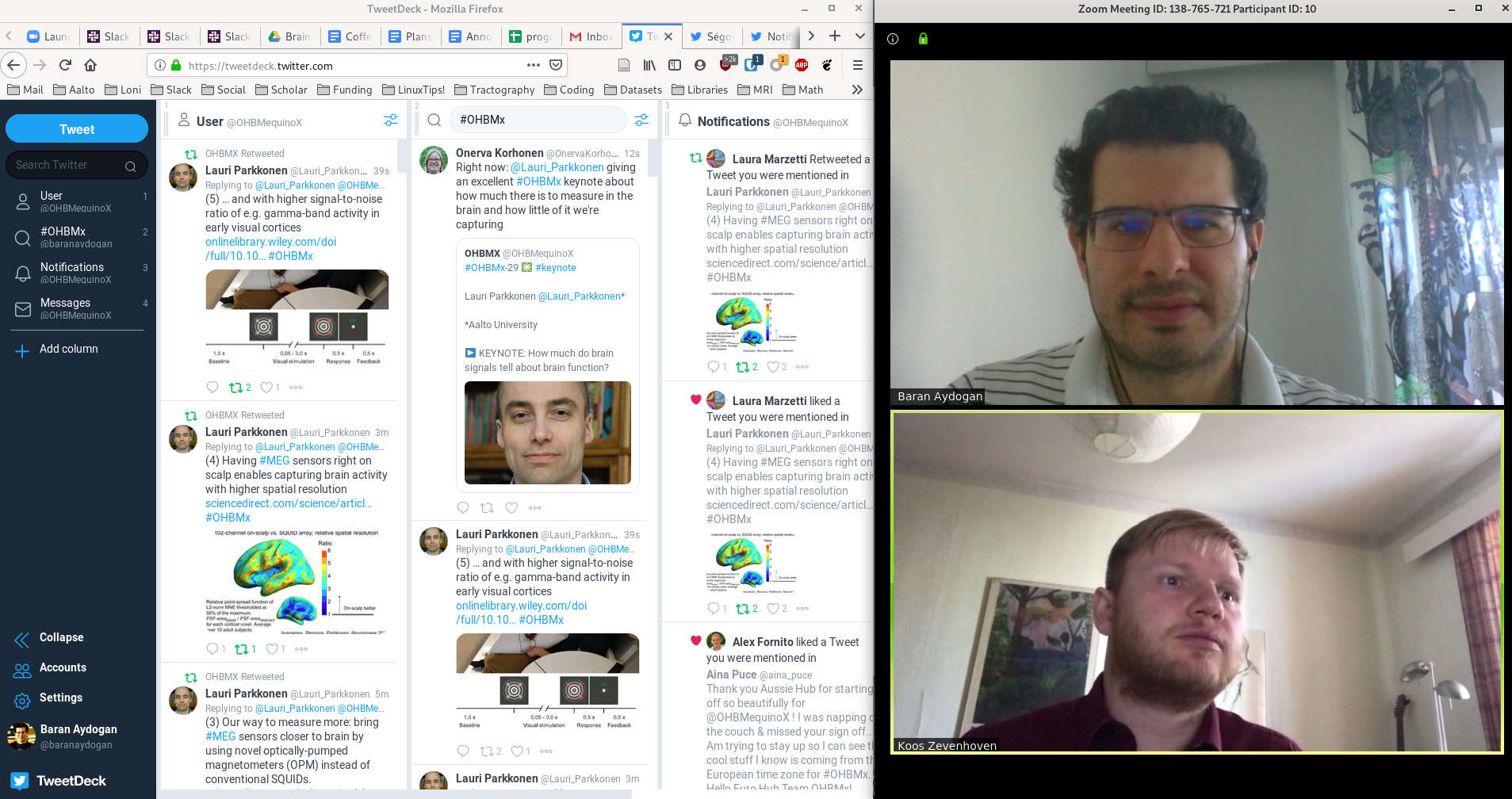
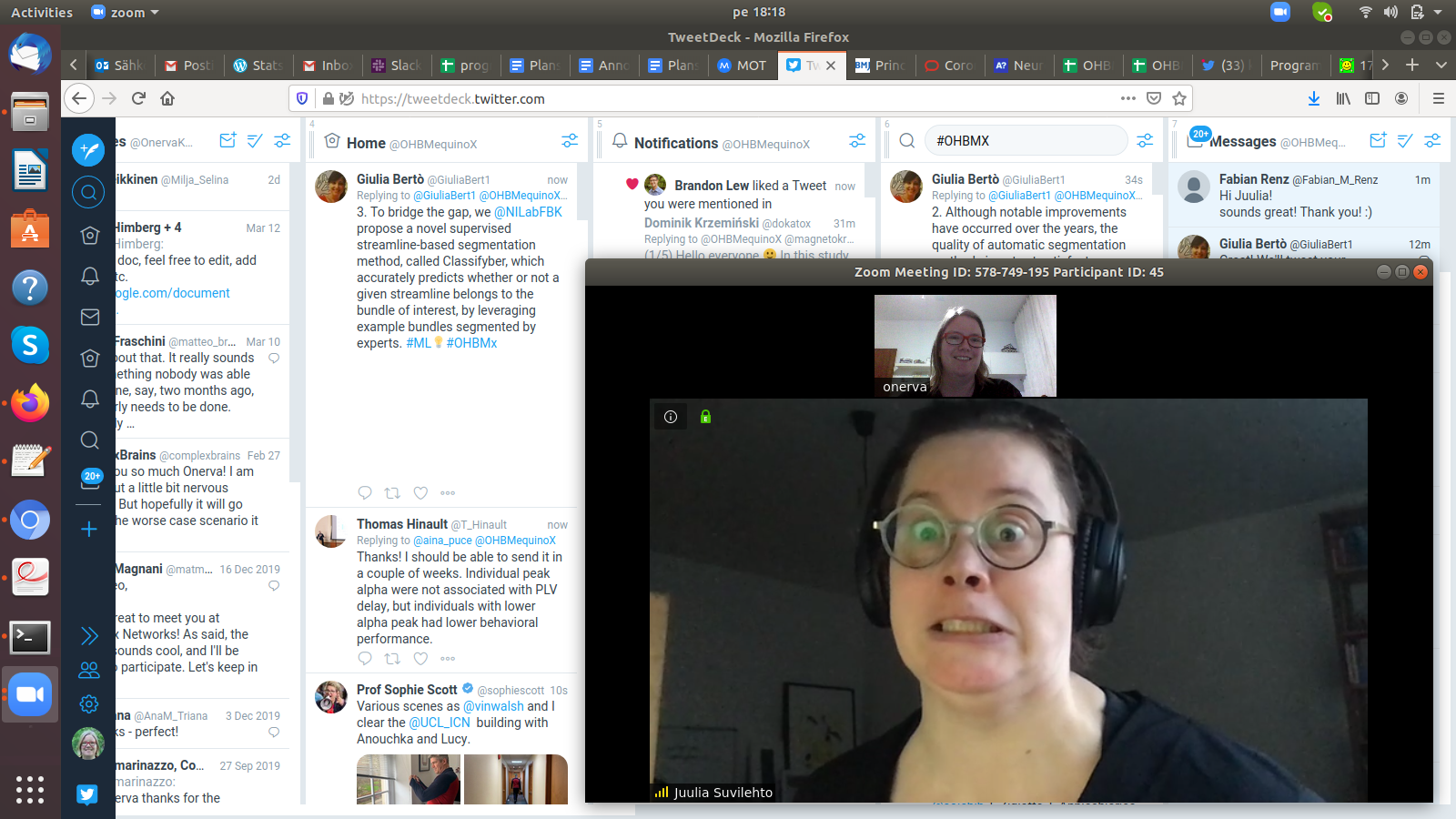
So here are some action shots of Euro hub TeamOHBMx hard at work chairing their respective sessions during their stint at the control panel of the meeting: Michele V & Juulia, Onerva, Onerva & Narayan, & finally Baran & Koos.

MicheleV&Juulia

OnervaCouch

Onerva&Naryan

Baran&Koos

And a reaction to something going awry – not necessarily on the ongoing [visible] Twitter feed, but behind the scenes – which we were all monitoring in Slack as well – I had it on my cell phone while looking at the #OHBMx Twitter feed on my laptop. [Permission by Juulia to post this shot…]

Juulia

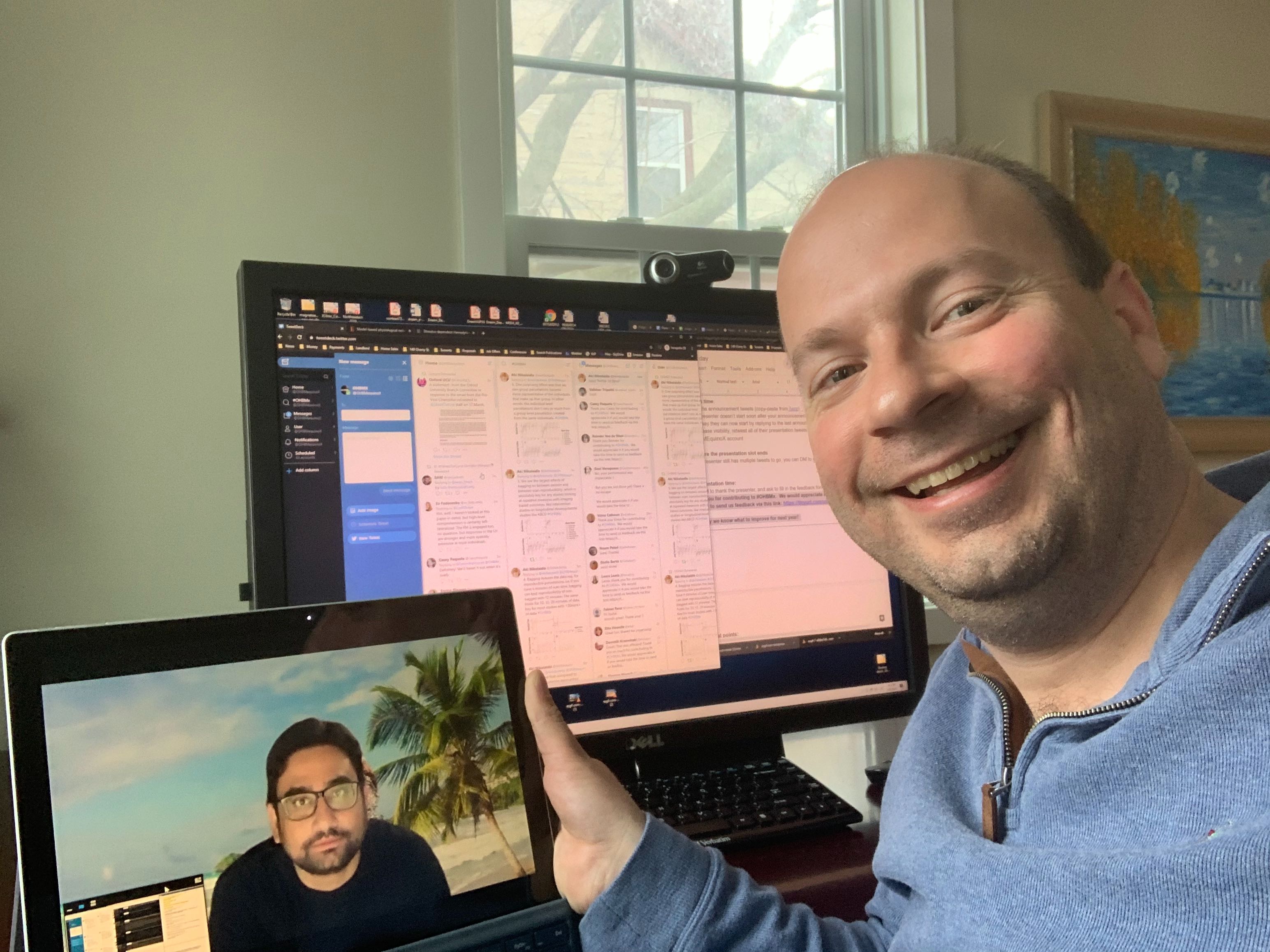
The hub baton was handed over a third time to the Team OHBMx US hub – with Dimitrios Pantazis & Sheraz Khan at the helm – again these are seasoned Twitter conference hubbers. So they approached things in a lay back way:

Dimitrios&Sheraz

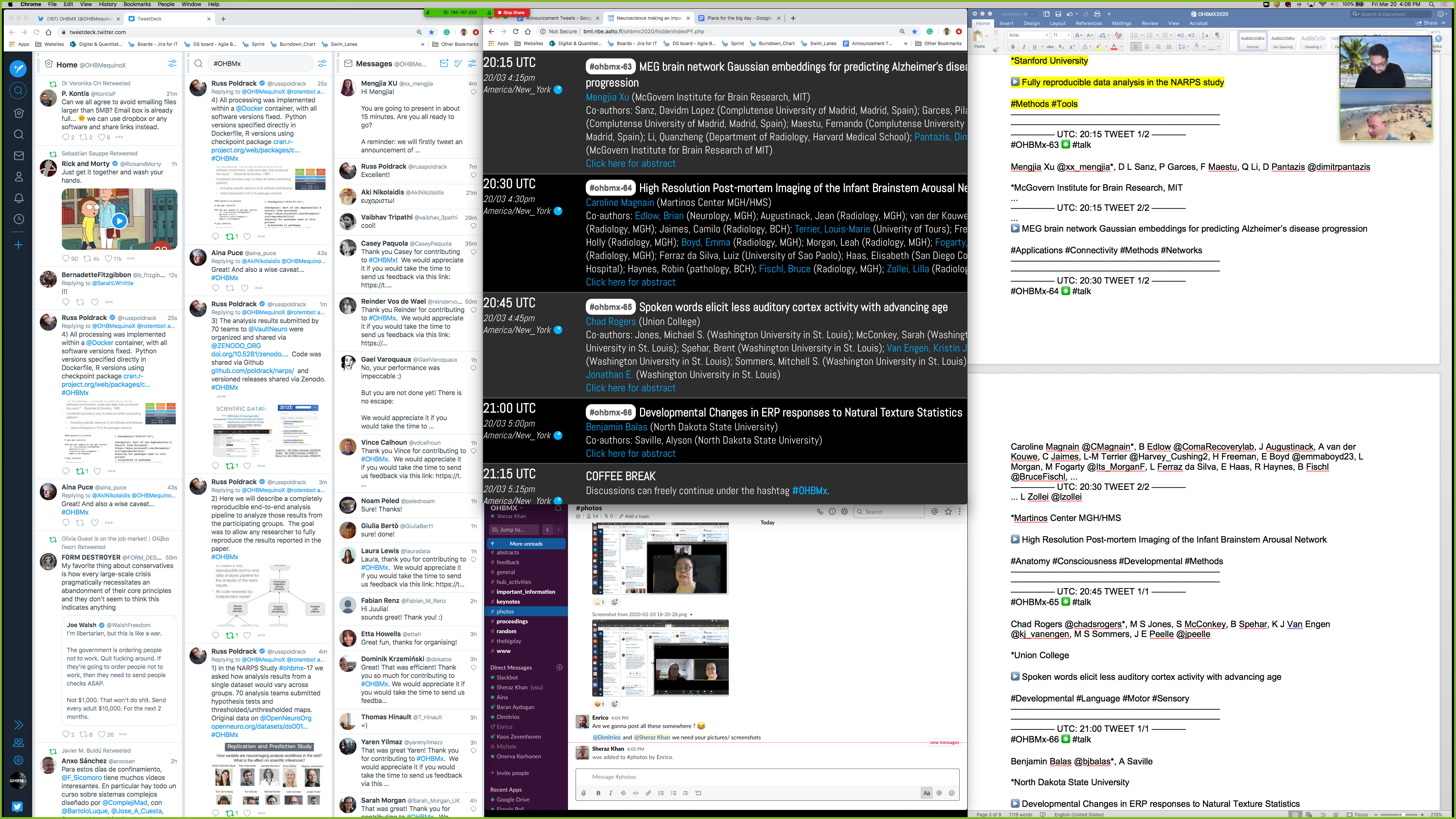
Dimitrios had it all under control using two computers & Sheran decided he wanted to be in a virtual Hawaii. Makes sense if you are in Boston at this time of year! They also tweeted that shot. That said though, here is a shot of Sheran’s screen:

LayOfTheLand

So he has it all going on on the monitor at once: the Tweetdeck #OHBMx feed, the #OHBMx program, Slack, & the Googledoc with the cue tweets to introduce each presentation. As you can see, there is a lot that has to be monitored at a time. Two people chairing at a time is needed – tweeters have to be contacted ahead of time to make sure they are ready, and current tweeters need to be monitored that they are keeping to time, posting appropriate content etc…

So here is a warning for those who want to do something like this. This is hard work. IMHO to organize this & run this meeting is in some ways is harder than running the main OHBM scientific meeting in June. The logistics are so complicated – presenters in multiple time zone to contend with [some regions with & without daylight saving], technical problems that tweeters might encounter that have to be solved remotely, alternate action plans needing to be implemented if a tweeter does not get their sequence of tweets right. And this happens, despite the given instructions to Tweeters. Why? Because we rely on technology to function perfectly. Sometimes this does not happen. I was a Keynote Tweeter in the #BrainTC conference in 2018. I was nervous & happily did not screw up, but I remember I had to totally keep my attention on task…

I am not going to feature the other Keynotes or Regular tweeters presentations here. They were all excellent – the quality of the science was truly exceptional – as one would expect of an activity tied to OHBM. What blew me away was the ability of the presenters to present incredibly complex work [data & analyses] using only 6 tweets. [Keynotes had 10.] Figures etc. were really informative for the viewer! Do check out the presentations by searching on the #OHBMx hashtag or the @OHBMequinoX feed. We had a plan to organize & make the contents accessible on the regular OHBM website. For now there are 2 options: 1. you can just search on Twitter using those #OHBMx hashtag or @OHBMequinoX. 2. Or, even better, why not use this newly minted tool created by Anibal Sólon [@anibalsolon]. He just told us about it today – see our Tweet below providing links to his resource, [thank you Anibal!!!]:

Now, also do not forget to check out the @OHBM_Trainees & their activities – get involved with the OHBM_Trainees, a special interest group [check them out on the OHBM website: https://www.humanbrainmapping.org/i4a/pages/index.cfm?pageid=3449]. They co-ordinate activities of our huge postdoc & graduate student membership. Lots of activities all year round – not just at the OHBM scientific meeting in June. Advice regarding careers & also chances to hook up with mentors who are senior scientists. [I have been a mentor thru this program – I recommend it. My mentee was a postdoc who went on to find a faculty position – I am delighted for him!] So check out OHBMx-73: their presentation at the Twitter conference for more information & of course also the OHBM website [see link above].

So, now that #OHBMx is over there is nothing else left to do but hunker down at home & teach & work the rest of the semester from home. That & LOTS of Zoom meetings! This means work & also play – we have already have had virtual dinners/drinks with friends in the evenings.

Stay well & remember to reach out to those who are isolated – people on their own that need to have some online/phone company…


@OHBMEquinox: Neuroimaging conferencing on Science Twitter?

OHBMX_logo_3_10_huge

Hanging out & just rotating around the sun. Recently I was reflecting on how long I have personally stood on our Earth as it made it’s daily rotations on it’s orbit around the sun. I came to the conclusion that I have been around the sun too many times than what I would like to actually admit to here… I also reflected on the number of friends & scientific contacts that I have enjoyed making over the course of these many rotations around the sun. I also did not want to particularly contemplate how much ionizing radiation I had subjected my body to in flying around to many locations in the world for well over 3 decades.

Using technology wisely to increase productivity? I have been resorting to using technology more & more – to regularly meet with collaborators across oceans, as well as give lectures to my students when I am either traveling, or when I am unwell. [ This is a great option when you do not wish to infect the rest of your building with bubonic plague. 🙂 Let’s be mindful & not spread the infection to others…] These virtual meetings have been great – lot’s of time saved not travelling. No jet lag either.

Taking the next step with technology. So, this makes me ask the question: if we can use technology to meet with friends, family & colleagues to discuss things, why can’t we organize scientific activities such as conferences using different virtual formats? Does this mean I am advocating that we all sit at our desks & watch video feeds of talking heads? No. Not at all. That would be awful.

We need to think about different ways to interact & present our science – ways which excite & engage our colleagues! I have had the pleasure of being involved with Science Twitter for about 5 years now. What a wonderful thing this has been! I have learned so many cool new things about neuroimaging – including getting new papers/preprints of fascinating new work by colleagues whose work I respect. I have also met so many people, made lots of new contacts. Amazing, when I have gone to scientific meetings e.g. Organization for Human Brain Mapping [OHBM] I have run into folks whose Tweets I have been reading & vice-versa. What a great way to make contact with those that you do not know! I have been able to invite folks out to IU to give talks & have also gone out to visit others & talk at their institutions, after meeting them on Twitter. How cool is that?

An OHBM Science Experiment. For the last 3 years the very capable young neuroscientists based at Aalto University in Helsinki have run a Brain Twitter Conference – with key note Tweeters & regular Tweeters. It has run for a day & has been a lot of fun – see previous conference abstracts/program from 2019 etc. here:  http://braintc.aalto.fi/2019/

This year we all decided to embark on a crazy experiment during the Equinox as our Earth takes a daily rotation around the sun – over a 24 hour period. It will be the Spring Equinox in the Northern Hemisphere, Autumnal Equinox in the Southern Hemisphere. Everywhere there will be an equal balance between the number of hours of day & night. Cool to contemplate, no? So as our Earth rotates around on this particular day – March 2020, we are going to devote it to neuroimaging/neuroscience! The new day dawns in Australasia first – so our Aussie hub – led by the inimitable @DrBreaky [a.k.a. Michael Breakspear] will start us on our journey. As the Earth turns during the day, we will turn to Europe/Africa/Middle East & to our Finnish hub – led by one of the architects of BrainTwitter conference @eglerean [a.k.a. Enrico Glerean] & the very capable & experienced team in Helsinki. Further on as the day nears its end we will be looked after by the experienced & seasoned US hub – led by the indefatigable @dimitrpantazis  &[a.k.a. Dimitrios Pantazis] in Boston. [Just as well – since his team will be closing out the day for us…] So as the Earth turns, we turn to 3 hubs who will co-ordinate our neuroimaging activities!

Where to get more information? Check out: OHBMx.org & submit an abstract soon! And check out @OHBMEquinox on Twitter. I will write another post with updates on the activities soon…

PuceLab couch surfers
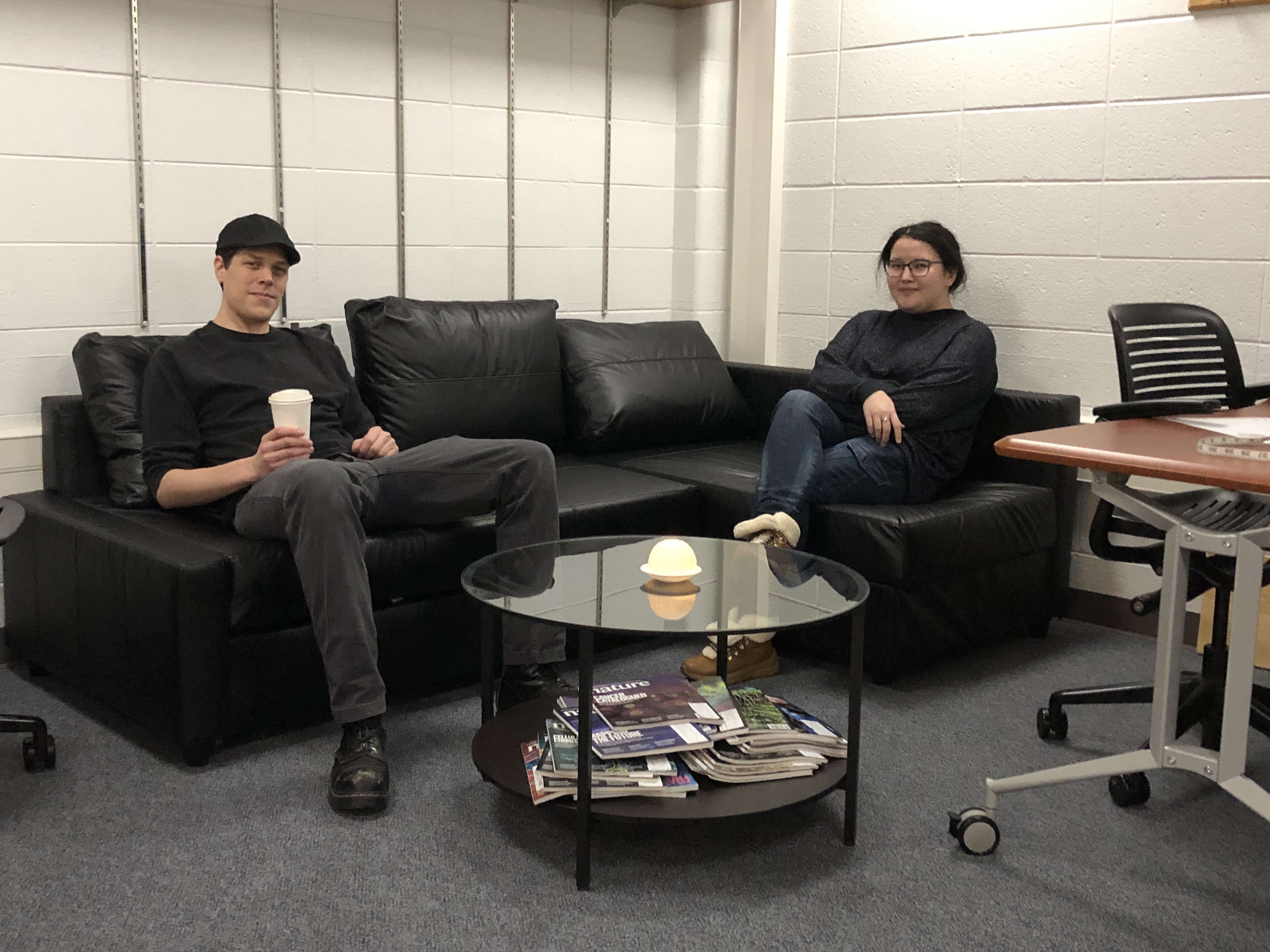
Matt Winter & Kami @salibayeva breaking in the PuceLab couch for Brain Twitter conference.

Meanwhile, our lab is ready for this: new couch/coffee table in the lab where we will be able to hang out & enjoy the fun on the Equinox – March 20! Note that this is also co-incides with Brain Awareness Week in many parts of the world – so consider including @OHBMEquinox #OHBMx in your activities on that Friday!

Even the creatures in Indiana are going nuts about this…

IMG_7755

…don’t miss out. @aina_puce


Some thoughts on conferencing in our current times


This is a very different of post to my previous ones – although the focus is still on traveling for science. Today I want to talk about what priorities we should set for improving the lot of younger scientists in our field.

Having returned from the annual neuroscience nerdfest attended by about ~ 29K attendees this year in San Diego, I got to thinking about what makes an excellent conference & what I personally find desirable about a scientific meeting. I typically only regularly go to 2 annual scientific meetings/year [but will, of course, go to additional ones if I get invited to speak at them]. The annual meetings that I have regularly attended for ~25 years or so are: 1. Organization for Human Mapping [which was held in Singapore this last June] & that typically has ~3K attendees; 2. Society for Neuroscience [SfN] [which just occurred in San Diego] & that typically has ~30K attendees. This year in San Diego the number was smaller – perhaps a consequence of the non-attendance of many foreign neuroscientists who were not issued visas by the American Government. This was very problematic – there were many empty poster boards – because the presenters were preventing from attending the meeting. There is currently a grass-roots push to lobby SfN to create a vehicle for these people to show & discuss their work. The science community is also petitioning SfN to give a complete refund for conference registration etc. for those people [usually trainees] who could not travel to SfN because of these issues. Flights & hotel room booking left many of those out of pocket – despite the fact that they could not attend the meeting. Incredibly, despite the SfN President publicly talking about inclusion & international participation in the meeting the entire week while we were in San Diego, the SfN has stayed silent & completely inactive on this issue [at least until the time of writing this post]. Is this because SfN is so large that the implementation of initiatives is stifled because of a large administration, or is it because the organization is just parochial? Not sure which alternative is more likely at this stage, but I have my suspicions.

So what, in my opinion, makes for a great conference – a meeting that will keep people coming back for more?

First, the most important thing is to provide a welcoming atmosphere that stresses inclusivity & safety for all delegates [an environment that is free of old white male dinosaurs inflicting their will [& themselves in some cases] on everyone…].

Achieving an environment like that requires that the society/organization that runs the meeting do more than just pay lip-service to these issues. There needs to be visible evidence of concrete initiatives to attempt to level the playing field for all & to push diversity. There should also be a very public declaration of what constitutes acceptable behavior at the meeting & associated social activities. Many societies are doing this now – including SfN & OHBM. We are generally pretty fortunate in science – scientists of all persuasions typically do come together & discuss science in a collegial way. Let’s tear down any remaining barriers that a minority of senior white male scientists put in the way to stop this from occurring. If need be, we might need to drown out those voices & also call out unacceptable behavior when we see it – this means dealing immediately with observed instances of racial prejudice or sexual harassment, or of senior scientists just taking up air time from younger ones whose views deserve to be heard… I am fortunate to say that this has never happened to me at a conference, but that does not mean that I am not aware that this is a problem. I had a pleasure of attending the Neural Oscillations Social at SfN – a wonderful evening hosted by Jonas Obleser & Saskia Haegens. At the same time as our social there was also a social on Neuroethics & the scuttlebutt I heard about this one was that this latter problem [hogging air time] had surfaced. Ironic isn’t it? Neuroethics of all things! I wish I had been a fly on that wall to know exactly what happened there – the ‘feel good’ vibe at the Neural Oscillations social was too good to leave.

OHBM has been good in setting up initiatives, such as a committee for diversity, as well as having discussions on the Program Committee that make sure that we have diversity in our Keynote speakers and so on. I know that SfN also tries to do this. What I would like to see more of in both societies, particularly SfN, is the recognition of scientific excellence that transcends gender. That was very apparent to me in San Diego as SfN awards were given out – the idea that scientific excellence can exist only in ivy-league institutions from work by scientists who have impeccable scientific pedigrees is very dated, methinks… As someone who grew up in another part of the world where funding for science was not as abundant, I learned that scientific excellence [e.g. good ideas, painstaking methods] are not reserved for elite institutions of learning – even though people over the years have tried to tell me so. [Seriously, this is what I heard a lot while I was at Yale – thankfully not from my mentors or the folks who worked in our laboratory].

Second, if inclusivity exists at a scientific meeting, this automatically sets up an open & free environment to discuss important, controversial & unresolved scientific issues – this is what pushes the field forward & everyone benefits from that! This has become a highly visible & positive component of the OHBM meeting. Why is this so you might ask? Because it comes down to the attitudes of the leadership of the society – if the leadership values these goals, then the meeting will get that overall feel. What has been good about the leadership of OHBM over the years is that it has tried to change with the times. OHBM Council has had both older & younger scientists as members & the older scientists have known what to do to remain current with the times. Unfortunately, I cannot see that SfN has changed in that way. I have been a member of SfN for 25 years & it seems to me that the leadership i.e. elected officers etc. has not reflected the diversity we have in the regular SfN membership. SfN will be 50 years old next year. This is an incredible achievement & something that really needs to be celebrated. What better way to do that by turning over a new leaf in the annals of the SfN & embracing diversity in all it’s forms? This means championing it, not only from the podium, but from concrete initiatives that are clearly visible to the membership, as well as using its considerable lobbying power to influence public opinion & politicians about science & making the world a much better place than it is today. I see this happening at the OHBM meeting yearly & I always come back from this meeting with a real buzz… If we cannot make the world a better place for others in the present, as well as for the future, then why are we practicing science in the first place?

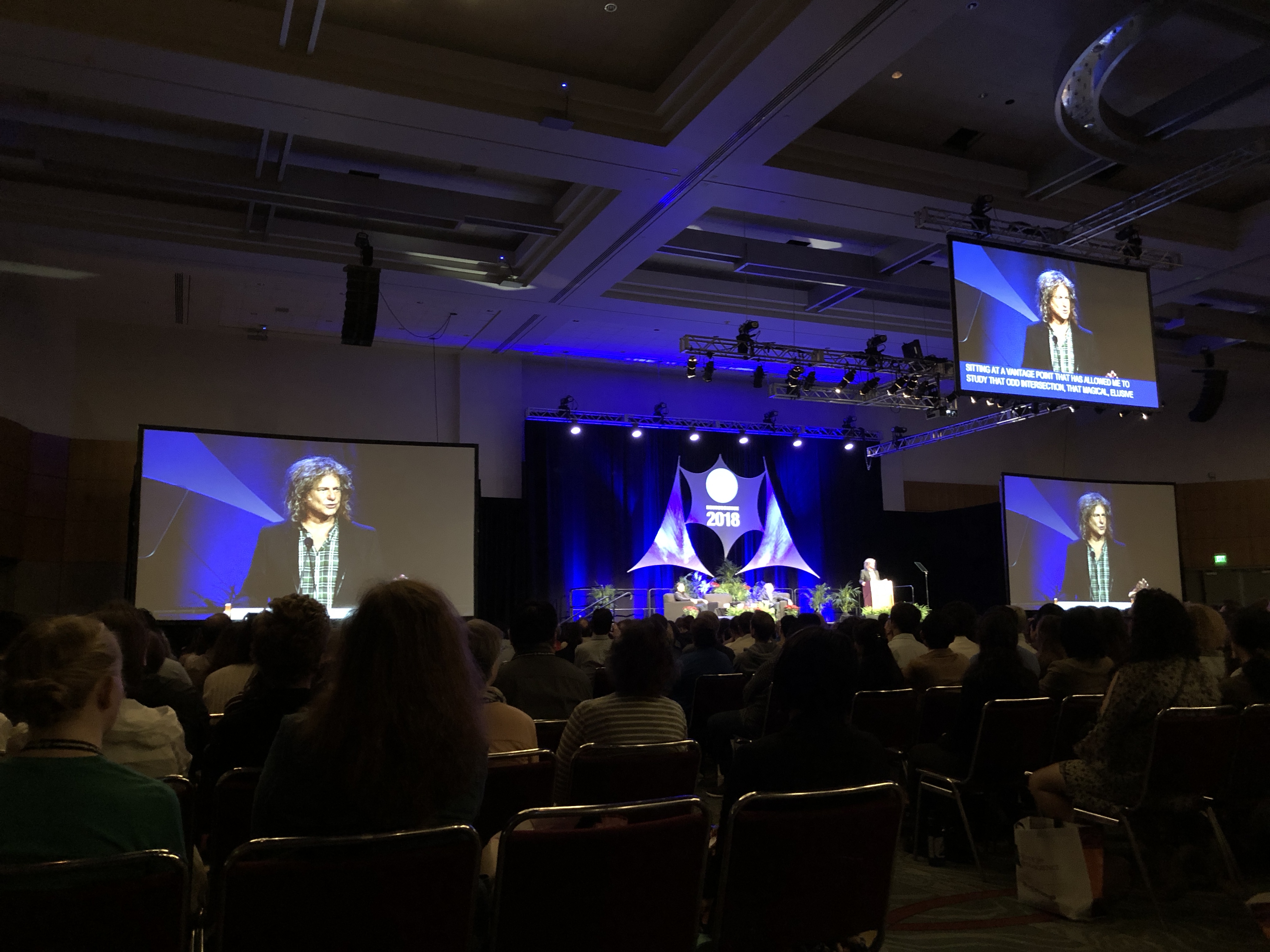
So as not to end on a negative note here: let me share with you my highlights of SfN. First, the session on the first day of the meeting, entitled Dialogues between Science & Society featured the very talented jazz musician & composer Pat Metheny. He was an absolute delight to listen to – he was able to clearly articulate about his very high goals that he sets himself for every performance, as well as giving the audience an idea of what goes through his mind as he improvises during a jazz solo & how he composes music.

SfN2018_2

Needless to say also, the special & keynote lectures were all excellent – with engaging & diverse speakers delivering accessible talks of a very high-standard to interested large audiences.

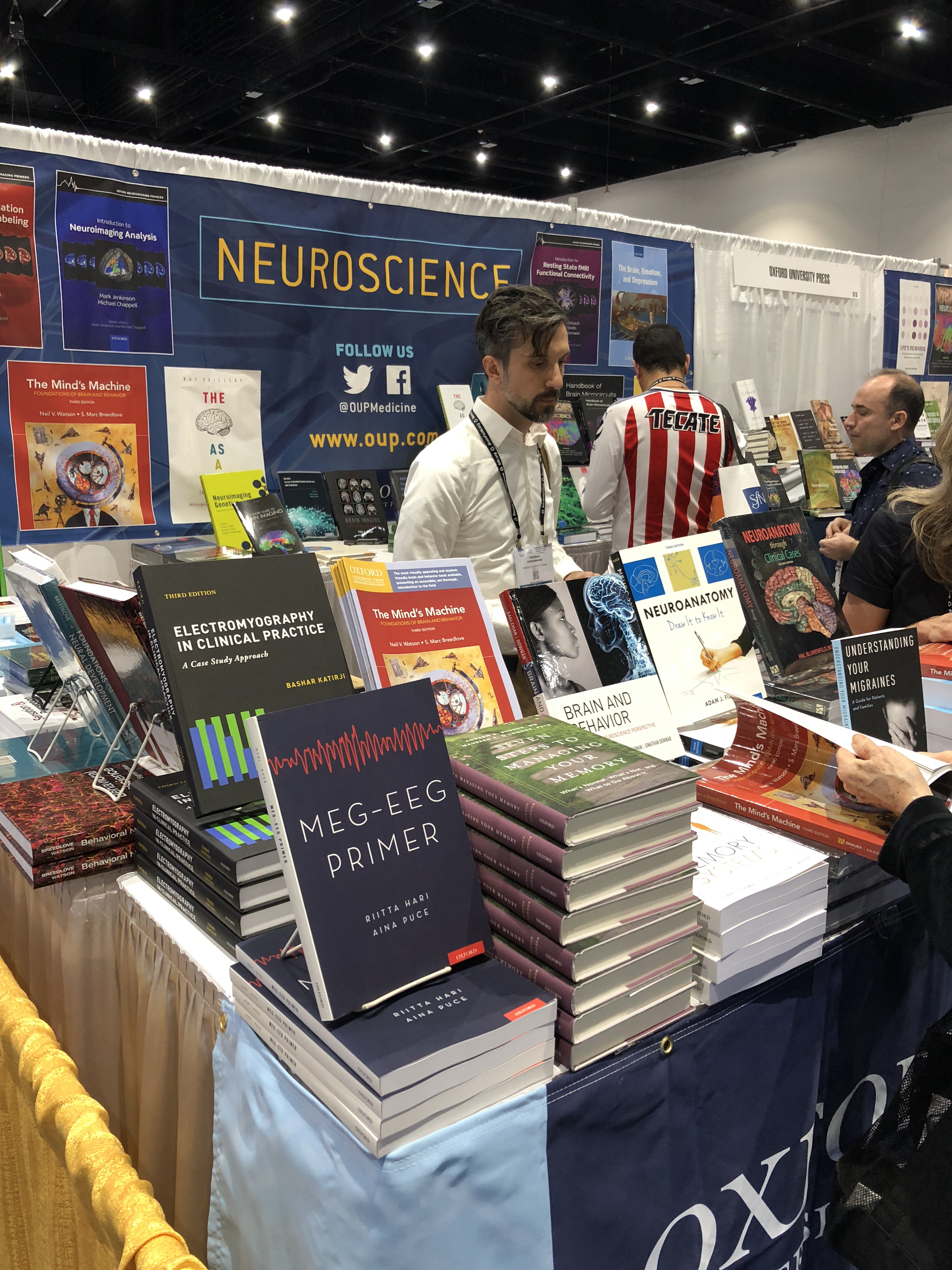
I did have a second highlight – a very personal one – almost embarrassed to admit it. But here goes anyway… as always I enjoy going around the commercial exhibits & looking for new equipment/software,& of course books. Nice to see our ‘MEG-EEG Primer‘ with Riitta Hari on sale at the Oxford University Press stand! So if you are new to MEG or EEG, check it out – it is targeted to you, & you might find it helpful… [see https://global.oup.com/academic/product/meg-eeg-primer-9780190497774?cc=us&lang=en& it is available on Amazon & Google Play]

SfN2018_4.JPG

OK. I admit it. That was a shameless promotion…

So at every scientific meeting you go to there is always an iconic image that remains with you after you have left the meeting. So what image will stay in mind from San Diego this SfN for me?

SfN2018_5